

Dental implants vs. dentures vs. bridges: which is right for you?
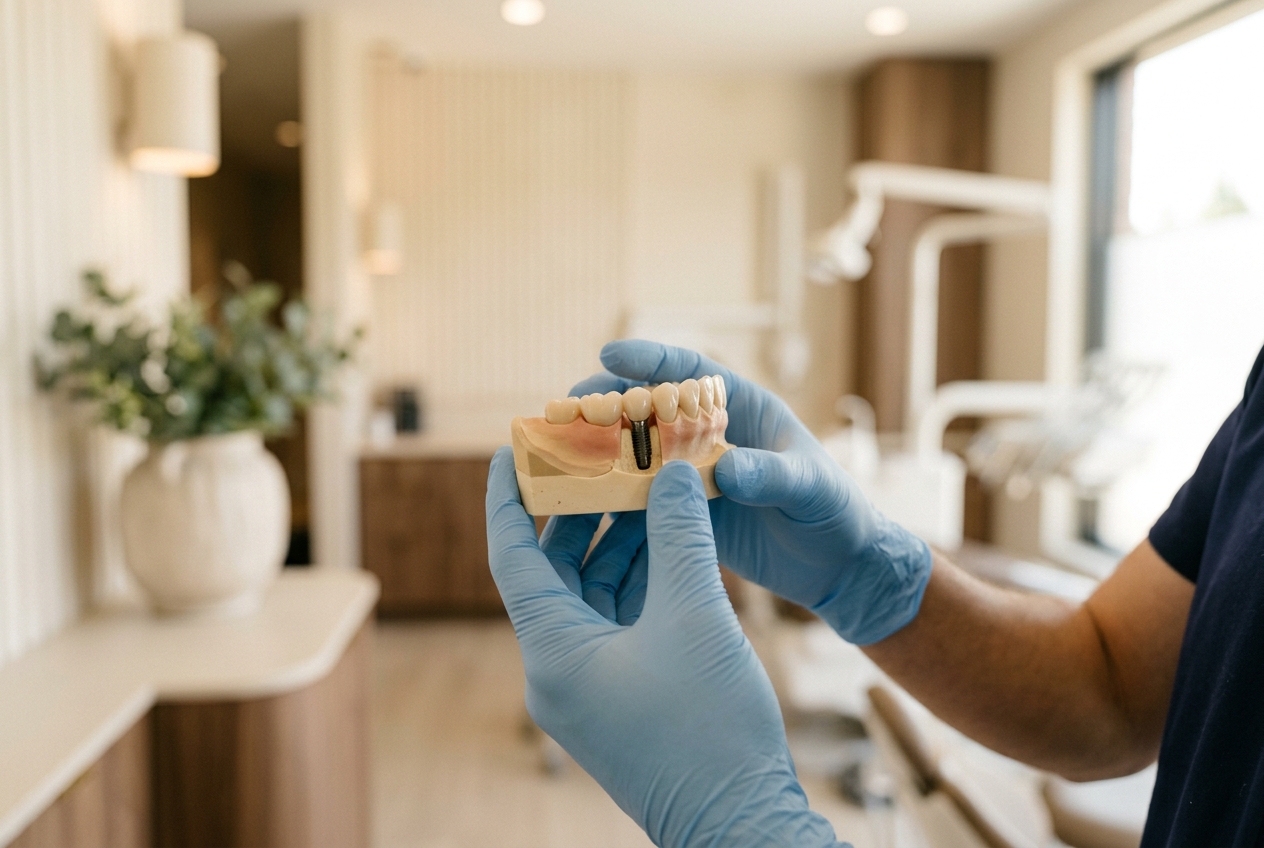
Losing a tooth affects more than your smile. It changes how you chew, how you speak, and — over time — the shape of your jaw. The good news is that modern dentistry offers three reliable ways to replace missing teeth: implants, bridges and dentures. Each has real strengths and real trade-offs. Below is how they compare, and how we help patients at Beechwood decide.
Quick comparison
| Dental implants | Bridges | Dentures | |
|---|---|---|---|
| How it works | A titanium post is placed in the jaw and topped with a crown — it acts like a tooth root. | A false tooth is anchored to crowns on the neighbouring teeth. | A removable appliance replaces some (partial) or all (full) teeth, resting on the gums. |
| Lifespan | 25+ years; often a lifetime with good care. | 10–15 years on average. | 5–10 years before relining or replacement. |
| Maintenance | Brush and floss like a natural tooth. | Floss under the bridge daily with a threader. | Remove nightly to clean and soak. |
| Feel | Closest to a natural tooth; fully stable. | Fixed and stable, though slightly different to the tongue. | Can shift or feel bulky; takes adjustment. |
| Relative cost | Highest upfront. We use premium materials built to last. | Moderate. | Lowest upfront, but replaced more often. |
Dental implants
Pros: Implants are the only option that replaces the tooth root as well as the crown. They look, feel and function like natural teeth, don't rely on neighbouring teeth for support, and help preserve jawbone. With good care they routinely last decades.
Cons: They are the biggest upfront investment and require a minor surgical procedure. Treatment also takes time — usually three to six months while the implant fuses with the bone before the final crown is placed.
A good candidate has healthy gums, enough jawbone to support the implant (or is open to grafting), is a non-smoker or willing to pause, and wants a long-term, low-maintenance solution. At Beechwood we invest in high-quality implant systems and ceramic crowns — this isn't a place we believe in cutting corners, and we'll give you clear pricing at your consultation.
Bridges
Pros: A bridge is fixed in place, restores chewing and appearance quickly — often within two or three visits — and doesn't involve surgery. It's a well-proven option that has served patients for generations.
Cons: The teeth on either side of the gap must be reshaped to hold the crowns, even if they're perfectly healthy. Bridges don't stop bone loss beneath the missing tooth, and they typically need replacing after 10–15 years.
Bridges suit patients missing one to three teeth in a row, who have strong adjacent teeth (especially if those teeth already need crowns), and who want a fixed solution without surgery or a long timeline.
Dentures: full and partial
Pros: Dentures are the most affordable and least invasive way to replace many teeth at once. A partial denture replaces several teeth while keeping your natural ones; a full denture replaces an entire arch. They can be made relatively quickly, and modern materials look far more natural than they once did.
Cons: Dentures rest on the gums rather than anchoring into bone, so they can slip, affect taste and speech, and feel bulky at first. Because the jaw continues to shrink without tooth roots, dentures loosen over time and need relining or remaking. Implant-retained dentures can solve much of this.
Dentures suit patients missing most or all of their teeth, those for whom surgery isn't an option, or anyone who needs a cost-effective solution now — with the option to add implants later for stability.
What about your bone and neighbouring teeth?
This is the factor most people don't hear about. When a tooth is lost, the jawbone that held it begins to resorb — up to 25% of its width in the first year alone. Implants are the only replacement that stimulates bone the way a root does, keeping the jaw and facial structure intact. Bridges and dentures leave that bone unsupported, which is why dentures loosen and why the gum under a bridge can slowly recede.
Neighbouring teeth matter too. A bridge requires grinding down the adjacent teeth, which can shorten their lifespan. A partial denture places clasps on them, adding wear. An implant stands on its own, leaving the teeth beside it untouched.
How to decide
Number of missing teeth. One tooth: an implant is usually the ideal choice; a bridge is the alternative. Several teeth in a row: implants, an implant-supported bridge, or a traditional bridge. Most or all teeth: full dentures or implant-retained dentures.
Bone health. Healthy bone opens every option. If bone has already receded, grafting may be needed for implants — or a bridge or denture may make more sense.
Budget. Dentures cost the least today; implants cost the most. But over 20 years, an implant that never needs replacing often costs less than a bridge or denture that's remade two or three times.
Timeline. Bridges and dentures can be completed in weeks. Implants take several months, but the result is built to last.
Frequently asked questions
- How long does each option last?
- Implants: 25 years to a lifetime. Bridges: 10–15 years. Dentures: 5–10 years before relining or replacement. Daily cleaning and regular check-ups extend all three.
- Does getting an implant hurt?
- The procedure is done under local anaesthetic and most patients describe it as easier than having a tooth removed. Mild soreness for a few days is normal and managed with over-the-counter pain relief.
- Will my insurance cover it?
- Most plans contribute toward bridges and dentures. Implant coverage varies — some plans cover the crown but not the implant itself. Our team checks your benefits in advance so you know your out-of-pocket cost before we begin, and we offer financing options for larger treatments.
- Can I switch options later?
- Often, yes. Many patients start with a denture or bridge and move to implants later. We can also add implants under an existing denture to lock it in place.
Not sure which is right for you?
Book a consultation with Dr. Gabi Micheli. She'll examine your mouth, take a 3D scan if needed, and walk you through every option — with clear pricing and no pressure.